Echo 01 · September 2026 · Brazil
The water came, but only after they buried Seu Luís
Eight years after occupying an idle estate on the edge of Campinas, 320 landless families have built gardens, clinics and classrooms out of nothing. The right to drink was conceded only after a comrade was killed on a march for water — and his face now looks down from the camp’s water tower.

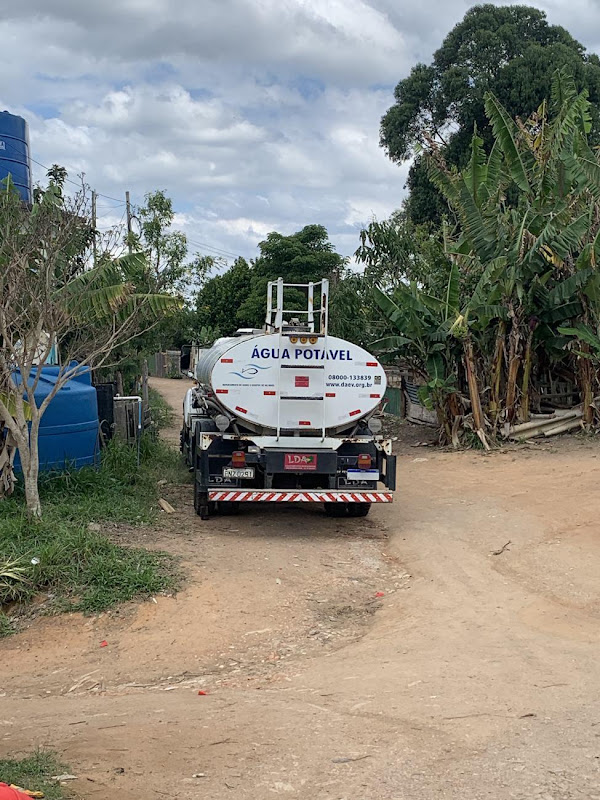
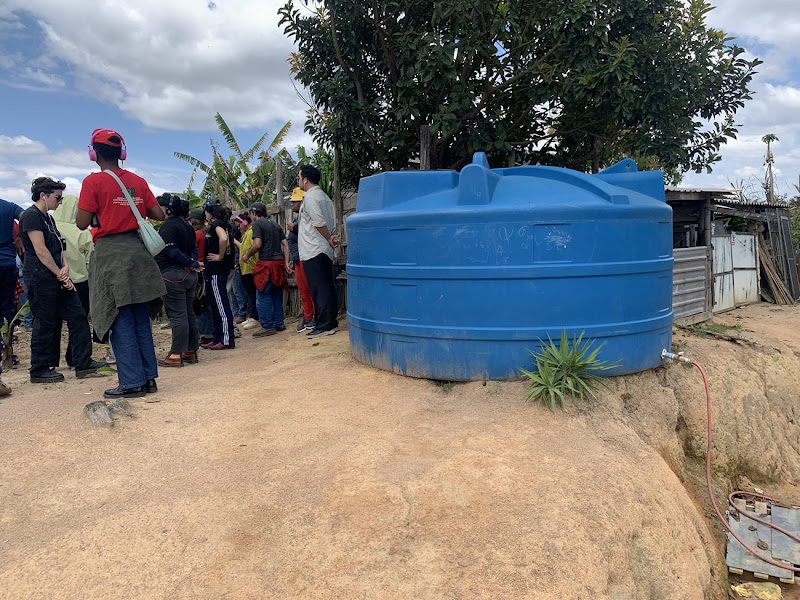
The road into Acampamento Marielle Vive is a strip of red dirt barely wide enough for a single vehicle. When the tanker turns past the banana stands, you hear it before you see it. Painted along the flank in blue: ÁGUA POTÁVEL — drinking water from Valinhos’ municipal water and sewerage department. It noses up the track, connects to a hose, and fills the blue polyethylene tanks stacked at the entrance. Eight years into this occupation organised by Movimento dos Trabalhadores Rurais Sem Terra (MST), that truck is the only reliable source of water for 320 families — more than 800 people.
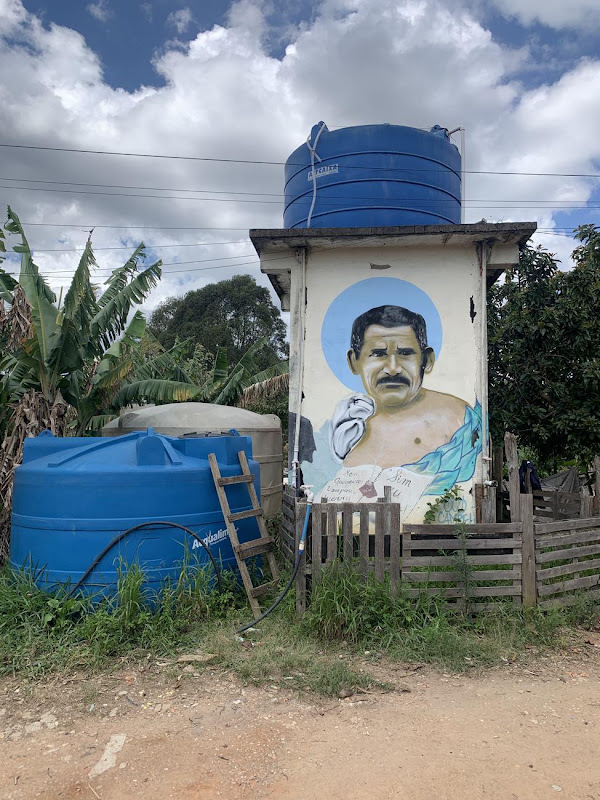
Above the tanks stands a squat concrete tower. On its face, haloed in pale blue, is an old man with a moustache and a towel over one shoulder. Water spills from his side. In his hands, painted small and carefully, is a school exercise book. He is Seu Luís, and he was killed on 18 July 2019 while marching down the Estrada do Jequitibá to demand that this camp be given water.
The tower he watches over was built afterwards as a symbolic reminder of the full story of this important victory.
The last lesson
On the blackboard of the camp school, in careful chalk letters: Hoje é quarta-feira, 17 de julho de 2019.
Cicera Alves Bezerra, 62, was the teacher. Her student that evening was Luís Ferreira da Costa, 72, a bricklayer everyone called Seu Luís. He was born in the sertão of Cariri, Pernambuco; moved young to São Luís, Maranhão; learned his trade there; and came south to São Paulo in 2002, settling in Campinas. He married Maria das Dores da Conceição and had six children, aged between 19 and 35. He helped organise the Marielle Vive occupation from its first weeks, and he was one of 40 people in the camp who were registered as illiterate or semi-literate and enrolled in the movement’s literacy course. He had twenty classes left — five weeks — before receiving his diploma.
That night, the lesson was on the syllables gue and gui, where the u is silent. He had been stumbling over them for two lessons in a row. Cicera put the words up on the board: gueixa, guerreiro, guerra, gueto, guepardo. Then she asked him to build sentences of his own, and from his chair he dictated two for her to write down.
Eu sou guerreiro. Eu vou para a guerra. I am a warrior. I am going to war.
Fifteen minutes before class ended, he rubbed his stomach and asked to be let go; he was hungry. Cicera told him to go and eat, because warriors need to be strong. His teacher remembers that, despite his age, he was determined to succeed; he came to class without fail, and a man who had arrived with limited literacy was now reading every short word she put on the board.
Eleven hours and thirty-nine minutes later, he was dead.
Eight thirty-nine in the morning
At 8:39 on the morning of Thursday 18 July 2019, around 500 people from the camp were on the Estrada do Jequitibá, near kilometre 7, handing out food grown under agrarian reform and leaflets to passing cars, and demanding that Valinhos supply the camp with water. Leo Luiz Ribeiro, 60, a salesman from the neighbourhood Jardim Eliza of Valinhos, accelerated a three-tonne Mitsubishi L200 out from behind a stopped bus, crossed into the oncoming lane and drove into them. The pickup went over Seu Luís’s head. Ribeiro did not stop. Witnesses say he was armed and threatened the people who tried to follow the vehicle. A journalist covering the protest, Carlos Filipe Tavares, 59, was also hurt.
A Brazilian flag sat on the dashboard. Ribeiro’s social media was a catalogue of the period: praise for Jair Bolsonaro and his ministers, and the criminalisation of the left. He confessed, was arrested at about half past five that same afternoon, and was charged with intentional homicide, causing bodily harm and fleeing the scene. The MST’s lawyer, Nilcio Costa, said he heard one of Ribeiro’s brothers say at the police station that the answer to people blocking a road was to put a truck over them, and the father said his son had done what he had to do.
Seu Luís died holding a placard. It read: “Water for Life and not for Death.”
The night before, he had written that he was a warrior going to war. He had meant the word guerra as a spelling exercise. The ongoing fight for agrarian reform and justice made it literal within twelve hours.

Before the death: a well, a hose, and a warning
Residents describe the years before 2019 as a slow attrition. There had been a communal well. Getting water from it to the households that needed it meant carrying, hauling, pushing it uphill along these same tracks — and people doing that work were watched, followed, and intimidated. The camp sits in one of the wealthiest corridors of the Campinas metropolitan region, hemmed in by gated housing complexes/condominiums. Since the families arrived in 2018, the municipality has refused to provide them with water. Dealing with the lack of water was simply part of residents’ routine, including Seu Luís’s family.
Maria de Lourdes, 74, who lives in the camp, put it without ornament in the days after the killing: he was sacrificed for water, and had the mayor of Valinhos been supplying them, he would have been alive. The mayor at the time was Orestes Previtale.
The municipality would prefer to read this detail differently. Valinhos city hall had a meeting scheduled about the camp’s water supply for Wednesday 17 July — the day of Seu Luís’s last spelling lesson. The meeting was postponed to Thursday the 18th. That is the morning he was killed on the road, demanding the thing the meeting had been convened to discuss. City hall also told reporters that tanker deliveries had begun that same week. The families were on the Estrada do Jequitibá that morning anyway. What is not in dispute is that whatever arrived, arrived by truck, not pipeline.

The tanker comes every day now. But a daily truck is not a water supply; it is not secure. It is a daily reminder that the supply is treated as charity that can be withdrawn rather than a right that must be sustained.
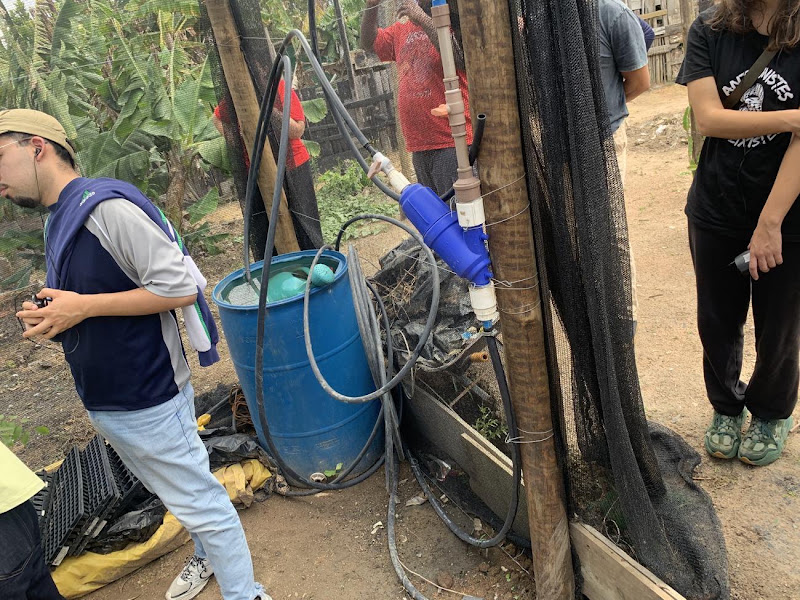
What arrives by tanker is immediately socialised. It goes into a central cistern and is distributed through the camp’s own infrastructure and production sector, which is responsible for water. Nothing about the system is private.


What the water built
It would be easy to characterise Marielle Vive as a community marred by scarcity. If, however, you stand in it for a day, it becomes clear that the opposite is true. It is one of the most productive stretches of land for kilometres in any direction.
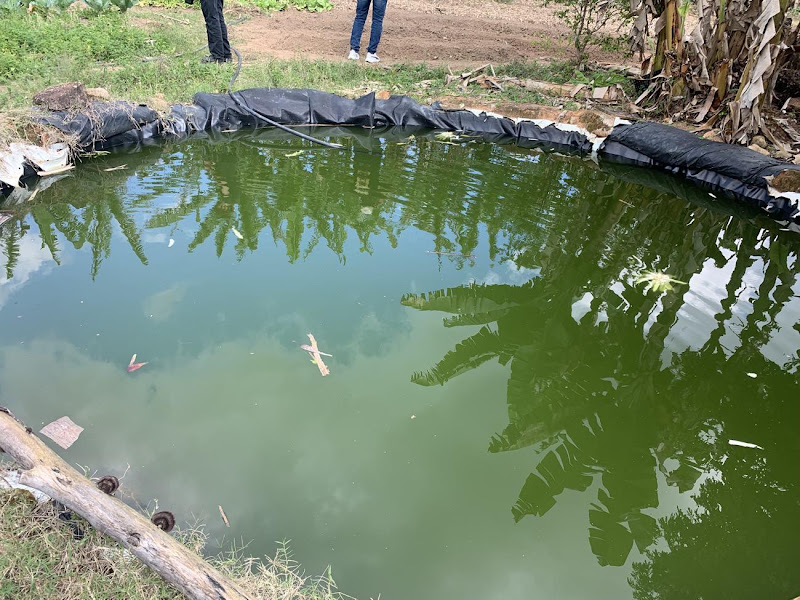
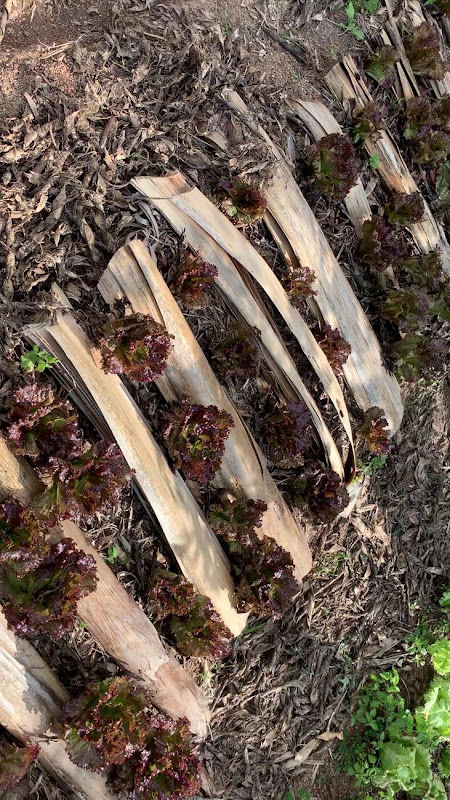
A lined reservoir holds a deep green pool. Fish live in it—not for the table, but to keep the water oxygenated and alive. Below it, the mandala garden, a circular agroecological bed self-managed by the residents, produces vegetables, beans, maize, cassava and pumpkin without pesticides. Lettuce is raised between split banana stems laid flat on the mulch, so the stems hold moisture in the ground and then rot into it — on land with no piped water, every litre of water is saved through advanced cultivation techniques. A seedling nursery, the Viveiro Roseli Nunes, raises trays of transplants under shade cloth. Medicinal plants grown in the same beds are processed by the health sector into tinctures — the camp’s own pharmacy, next to the cleared space kept open so an ambulance can reach the centre of the settlement. Through the entire pandemic, coordinators say, the camp did not lose a single person to Covid-19.


Ask people what drew them here and the answer is rarely romantic. It is the arithmetic of the periphery: rent that cannot be paid, work that does not cover it, and a city that had no room. What holds them is something else — that the agroecological life on offer here turned out to be dignified.
Fifteen base groups, nine sectors
The camp is organised into 15 base groups. Each is led by one man and one woman, or by two women, in a context where gender parity is considered a point of departure rather than a destination. Nine sectors run across the 15 base groups: education, production, kitchen, warehouse, security, health, childcare, sport and culture, and youth. Psychologists from a nearby university work alongside the children’s brigade. A literacy campaign runs continuously.
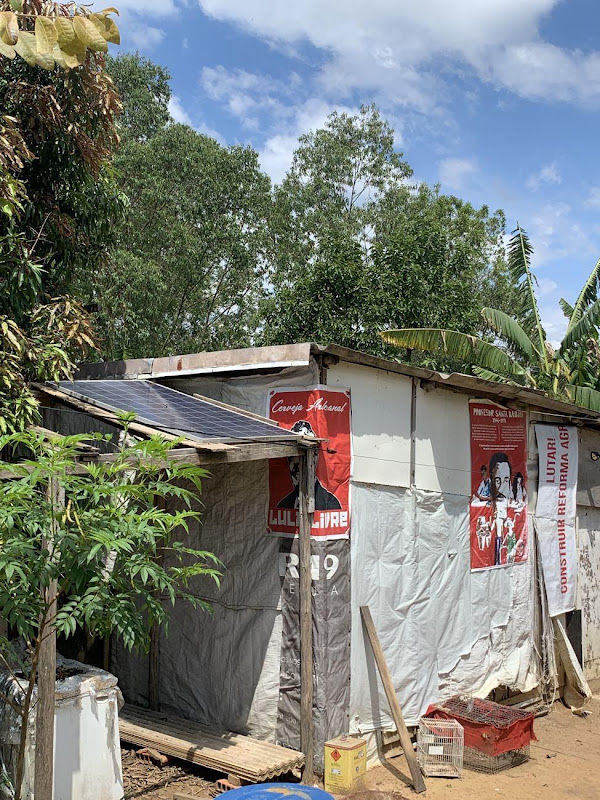
Security is the sector nobody wanted to need. The access points are staffed around the clock, with each base group taking two shifts per week. People have been shot at from passing cars. Drivers slow down to shout at them. From the beginning, the camp’s leadership advised families not to leave the site wearing the MST’s cap, shirt or colours — a caution that says as much about the neighbourhood as any statistic could. Formed by rural workers through the occupation of latifundios, or large landed estates, the MST is the country’s mass social movement fighting for land reform and against injustice and social inequality in rural areas, and has led more than 2 500 land occupations in the past 20 years.
The MST was founded in 1984 by peasant leaders in Cascavel, Paraná, growing out of rural struggles in the early 1980s and drawing on the organising by the Catholic Church’s Pastoral Land Commission. Occupying land has been its central tactic from the start, and agrarian reform means more than dividing up estates; it means agroecology at the core of farming and land use. Their struggle unfolds in two stages: encampments and settlements. First, families occupy an estate and build their homes (encampments) there while urging the state to recognise their claim to the land. Then, securing a legal title makes the encampment a settlement organised within the greater movement. Around 450 000 families have won land this way, with some 65 000 more remaining in encampments.
But this type of organising and occupation comes with a cost and is regularly met with police force and armed attacks. In Marielle Vive, residents say the police have not been a solution but part of the problem — the camp is legally protected, and it is private business, protected by the state, that has been attacking it. In the early days, officers tried to enter, and movement lawyers were compelled to intervene and stop them.
The camp is close to the city — that proximity is both its economic lifeline and the reason developers want it gone.

Schooling, and the cost of being called illegal
For years the camp’s status as an “illegal” occupation was used to keep its children out of formal schooling — no address the system would recognise, no transport that would come this far up the track. That has shifted: public transport now reaches the camp, and children attend school outside. Inside, adult and youth education classes continue, and young people are routed into agrarian reform education programmes and courses at the movement’s national school, the Escola Nacional Florestan Fernandes.
Seu Luís never collected the diploma. He was five weeks short of obtaining it. When the movement laid out his memorial, they still set the literacy certificate beside his work tools.
The camp’s own school is painted across the wall of one of its buildings, and it carries his name: Escola Popular Luís Ferreira. He is on the left of the mural, the same lined face as on the tower and the frame. Marielle Franco – a black city councillor from the Rio de Janeiro favelas shot dead in March 2018 for standing in the way of politicians who were seizing public land for private real estate – is on the right. The families that occupied the land exactly one month later named the camp after her. Between them, painted in black line across a whitewashed block, are families in the rows, children carrying crates of fruit, an MST flag, a hillside of houses. A man who was learning to read at 72 when he was killed now has a school named after him, and the two faces that watch over it are the two people this camp buried into its own name.
Why this matters
For those organising to reclaim land and livelihoods across Africa, Marielle Vive is not an exotic case study. The pattern is familiar to anyone who has stood on contested ground in Zimbabwe, South Africa or the Alliance of Sahel States (AES): land held out of use by capital while the people who would farm it are declared criminals for wanting to; water and power withheld not because they are scarce but because withholding them is a strategy of exhaustion; and a state whose armed and legal apparatus arrives on the side of the developer.
What is also familiar — and this is the part worth carrying home — is the answer. Not a petition, but an organised life: base groups with women in command, sectors that run health, education, and food, a literacy campaign that treats a 72-year-old bricklayer’s reading as a political act, and a refusal to leave. That is what dignity looks like when people who need it have to build it from the ground up.
The tanker will come again this week. Seu Luís will still be on the tower when the pipes finally arrive.

Sources and background
- Brazil (1988) Constituição da República Federativa do Brasil, arts. 184 and 186.
- Field notes and photographs, delegation visit to Acampamento Marielle Vive, Valinhos (SP), 19 September 2026.
- MST, Acampamento Marielle Vive em São Paulo: entenda a história de luta e resistência, 1 December 2021.
- MST, Marielle era uma de nós, 27 June 2019.
- MST, Acampamento Marielle Vive celebra quatro anos de resistência em ato contra a violência no campo, 20 April 2022 (originally Brasil de Fato, by Nara Lacerda).
- MST video record of the INCRA demonstration against the eviction order, São Paulo, 2021.
- MST, “Apesar da idade, queria vencer”: antes de ser assassinado, Luis foi à escola do MST, 19 July 2019 (originally Brasil de Fato, by Igor Carvalho).
- MST, Polícia prende homem que confessou ter assassinado militante do MST em Valinhos (SP), 19 July 2019 (originally Brasil de Fato, by Igor Carvalho).
- MST, Marielle Franco, presente!, 15 March 2018.
- Maíra do MST, Marielle Franco e o MST: lutas compartilhadas pelo povo, Brasil de Fato, 25 February 2026.
- Tricontinental: Institute for Social Research (2024) The Political Organisation of Brazil’s Landless Workers’ Movement (MST). Dossier no. 75, April.