
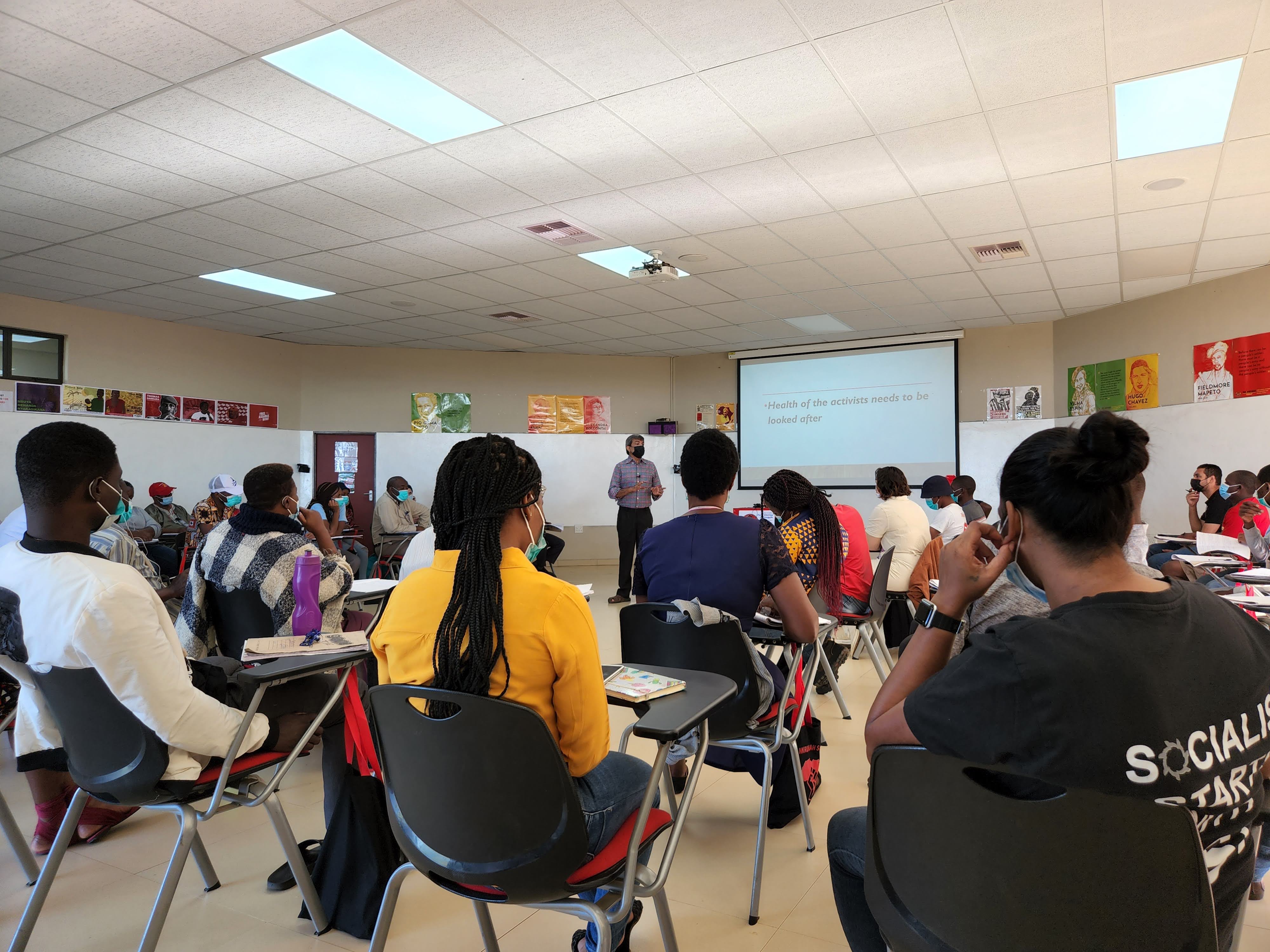
The Nkrumah School
In November 2016, we launched our first three-week immersive educational course at the Nkrumah School in South Africa. Since then, the school has become a well-regarded institution for popular education in Africa.
The school employs dialogue and popular education to encourage collective discussions about global and continental challenges, encouraging the adoption of progressive actions that effectively improve conditions for marginalised groups to oppose oppression and exploitation. It explores various thematic areas, including Economics, History, Political Theory, and Philosophy, as tools for analysis and avenues for social transformation. Throughout its activities, the school strives to create an environment that emphasises the importance of unity among the peoples of the African continent and beyond.
Since 2016, we have organised over 20 multilingual international courses and more than 10 regional courses, directly training over 2,500 activists. Each course targets specific goals such as promoting international solidarity, capacitating trainers, empowering popular communicators, or enhancing trade union education. The courses are delivered concurrently in multiple languages, including English, Kiswahili, French, Portuguese, IsiZulu, and Sotho.
Our educational project is rooted in strong connections with various civil society organisations across the African continent, aiming always dialectically to combine ideas with practical application actions.
As facilitators, we engage leaders of popular organisations and scholars from across the continent and around the world. In our experience, those with backgrounds in civil society organisations offer particularly unique insights during discussions. Facilitators introduce some of the most contemporary and relevant theories and experiences into the classroom environment for activists to learn from.
This network of facilitators, along with representatives of civil society, support the delivery of materials and the exchange of experiences and ideas between participants in our courses. PAT’s multilingual and multidisciplinary approach enables us to engage organisations across the continent and develop a truly Pan African pedagogical experience.
Workers Power
The Workers Power Program, our flagship initiative, is a powerful platform for workers and trade unions to discuss their rights, share their perspectives, and build collective strength. This program is not just about empowerment, it’s about inspiring workers to fight for their dignity and economic justice. Through these discussions, it promotes the cause of workers’ rights and equality, leaving a lasting impact on the fight for social justice.
Episode 1: Welcome!
Episode 2: Just energy transition, climate change & more
Episode 3:What is Austerity? with South African economist Duma Gqubule
Episode 4:NUMSA JC Bez region political induction and education program
Episode 5: The history of Palestine
Episode 6:NUMSA Ekurhuleni region political induction and education program
Episode 7:‘There Can Be No Freedom Without Land’ with Mqapheli Bonono
Episode 8:What is happening with workers at PUTCO?
Episode 9: “Socialism speaks to people’s needs!” with U.S. Presidential candidate Claudia De La Cruz.
Episode 10:“Stand with Palestine! Ceasefire now! End Israeli Apartheid!”
Episode 11:We demand a double-digit increase! We demand an increase in the allowance for the double driver!
Episode 12:What’s happening with the Road Accident Fund?
Episode 13:SAICWU unpacks the strategy to defend workers in the food sector!
Episode 14:Unpacking NUMSA international work and more!
Episode 15:Remembering the revolutionary legacy of Chris Hani
Episode 16:What are the challenges in South Africa’s security industry?
Other Education

Decentralised Courses
Decentralised courses are an integral part of our educational strategy. While most of our courses are residential and held at the Thuto Centre, decentralised education occurs at a grassroots level, interfacing with the everyday reality of organisations. This approach ensures that education is not confined to a specific location or time, but is an ongoing process that can be accessed and applied in various contexts, thereby promoting inclusivity and diversity in our educational initiatives.During the COVID-19 pandemic, we used the period when large gatherings were restricted to expand these decentralised programmes. The PAT Secretariat focused on embedding the most relevant and transferable elements of the Nkrumah School into the core of the organisations. This targeted approach delivers education directly to the site of struggle and enables participants to integrate analytical tools with on-the-ground organising.

Webinars
Our webinars bring together thought leaders and activists from around the world in a virtual setting. Despite being separated by rivers and forests, these webinars enable critical conversations to continue. They cover important issues facing Africa today, providing analysis, strategies, and opportunities to build solidarity among diverse movements. These webinars are not just about sharing knowledge, they are about fostering a sense of global solidarity and unity in our fight for justice.